Incumbent Advantage turns the trust, history, and access your team has already earned into genuine, valuable partnerships with your clients — not just protected revenue. Happier, better-served customers are the point. A harder-to-replace account is simply what happens along the way.
Most CS tools flag who's about to leave. This helps you build relationships good enough that it rarely gets to that point.
"When everything feels noisy and uncertain, we deliver accurate, calm, actionable clarity — so you can lead with confidence instead of fear."
70-90% of most companies' revenue comes from existing accounts — yet the data meant to protect those relationships is often the least trustworthy thing in the business.
Salesforce data is messy because humans enter it inconsistently, rarely update it, and use it for reporting rather than selling. The truth about a relationship lives scattered across email, calls, Slack, tickets, and spreadsheets — updated for leadership, not built for the person actually defending the account. This is the root of why every advantage below quietly erodes.
Six advantages every incumbent vendor already has — and exactly how they quietly erode without real intelligence behind them.
You should have it by default — but new CSMs inherit accounts with no relationship history, and past issues erode credibility before you even show up.
Without intelligence and insight, building trust becomes guesswork instead of strategy.
You should know the customer — but the truth is scattered everywhere. Usage, tickets, emails, calls, Slack. New CSMs spend weeks piecing together context that should already exist.
Without a unified view, insight becomes noise instead of leverage.
You should already be in the room — but org charts shift constantly. Champions leave, new stakeholders appear, influence changes overnight.
Without political intelligence, access becomes accidental instead of intentional.
You should benefit from the cost of leaving — but competitors know how to exploit uncertainty. Integrations only matter if the customer still remembers why they chose you.
Without proactive engagement, switching costs become invisible instead of protective.
You should own the account's history — but most of it lives in people's heads. CSMs leave, notes disappear, tribal knowledge evaporates. Customers remember everything; vendors often forget.
Without institutional memory, every renewal feels like starting from zero.
You should be deeply embedded in their workflows — but most teams can't articulate how. Competitors show up with a shiny demo and a clean narrative.
Without intelligence, embedded value stays invisible — and invisible value doesn't renew.
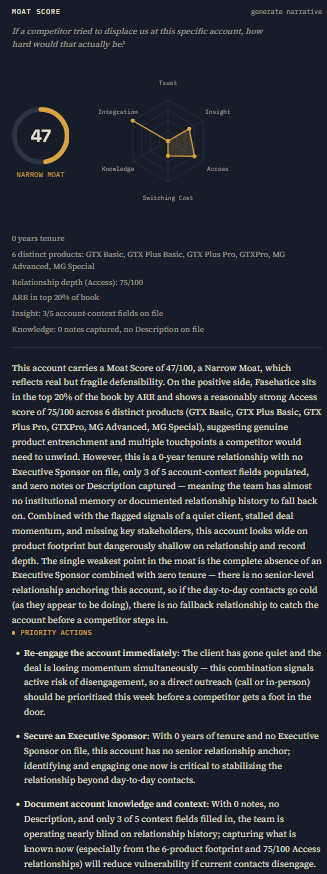
Our platform takes the real, sometimes uneven reality of being the incumbent and turns it into a strategic advantage — even when trust, insight, access, history, or stability aren't quite where you'd like them to be yet. This is exactly what Moat Score measures: all six advantages, turned into one real, trackable number for every account.
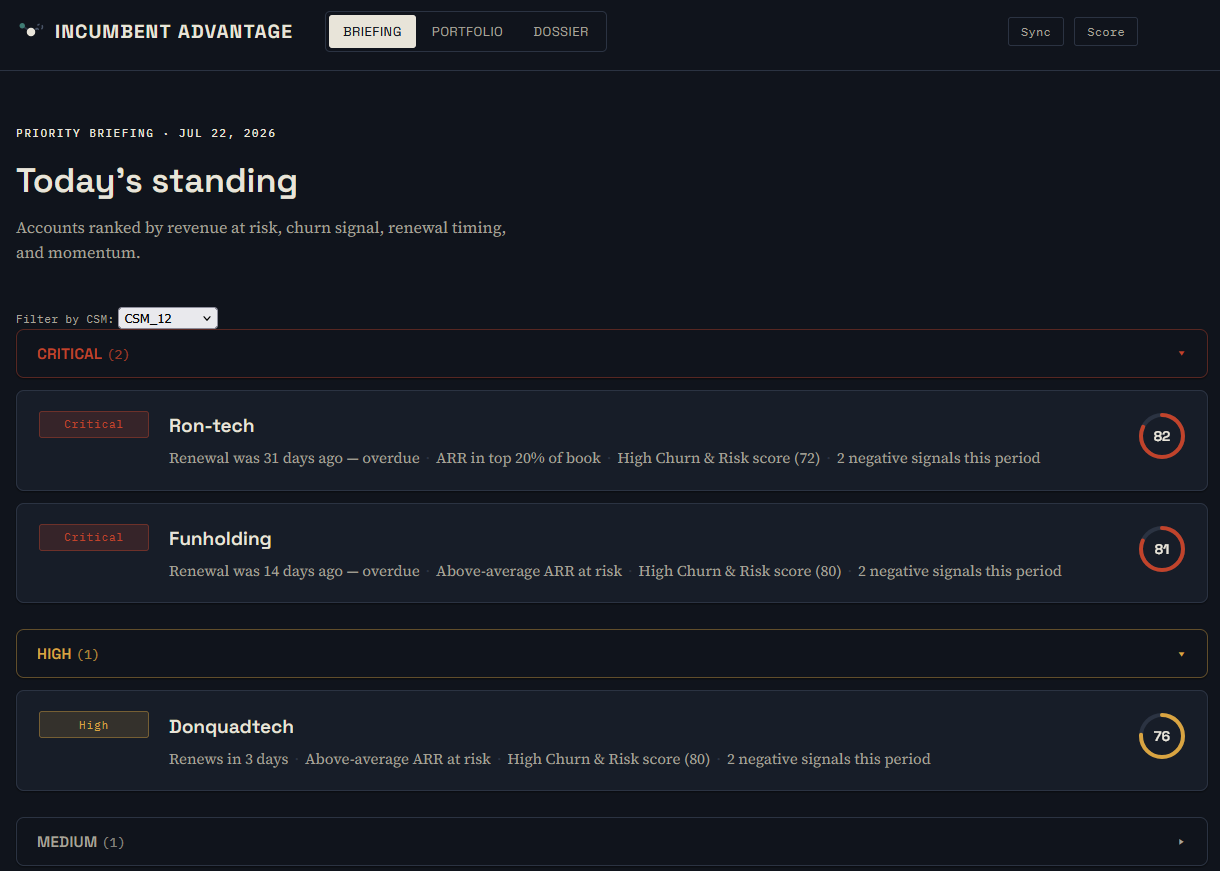
Accounts ranked by revenue at risk, churn signal, renewal timing, and momentum — read as a daily dispatch, not a dashboard you have to interpret yourself.
A real, six-dimension defensibility score — Trust, Insight, Access, Cost Switching Advantage, Knowledge, Integration — grounded in your actual account data, not a guess.
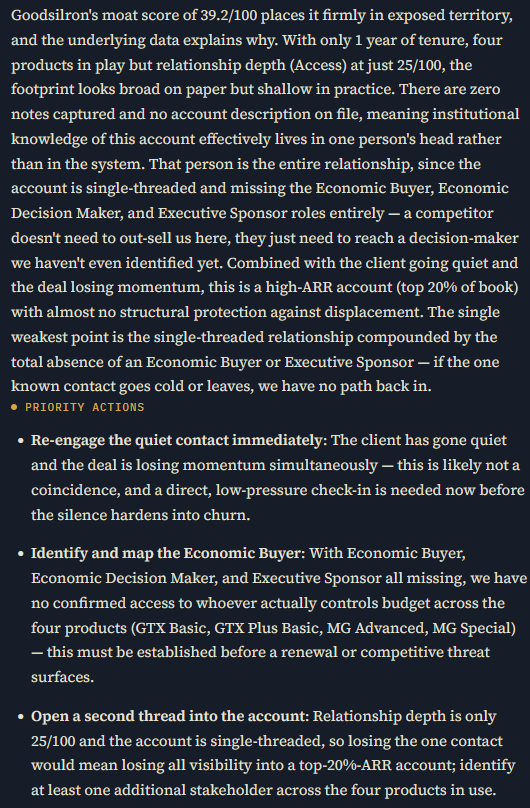
Every Moat Score comes with a written analysis naming the single weakest point in the account and exactly what to do about it, grounded in the real data behind the score.
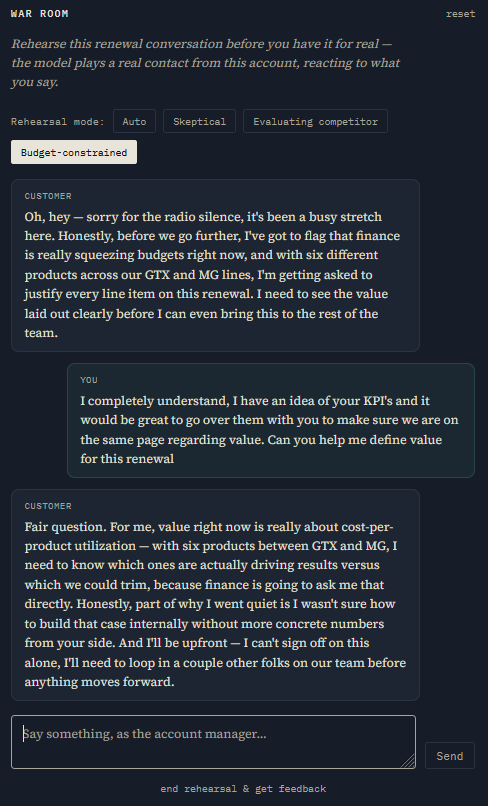
Practice a renewal or retention conversation against an AI playing a real contact from that account — grounded in the actual risks on file, not a generic script.
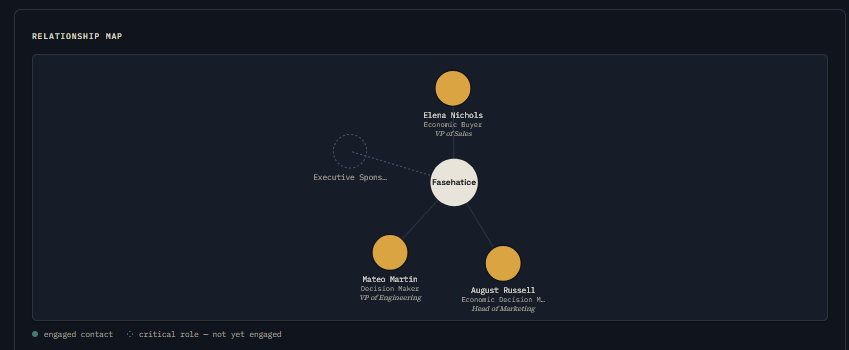
This isn't just a picture of who's involved. It's a real engine that turns the gaps in a relationship into a concrete plan — the strategy to close them, the words to use on the call, and the internal backing to get it done.
An actual stakeholder graph — who's engaged, in what role, and which critical roles are missing entirely, shown as a ghosted gap instead of just an absence.
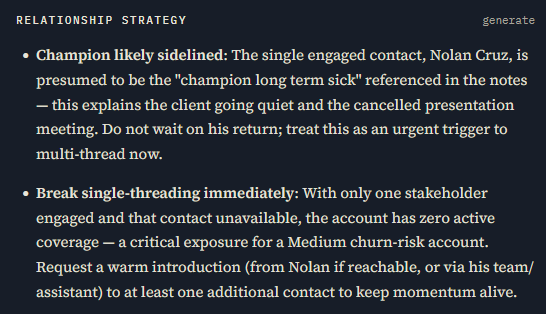
Every missing role and single-threaded risk becomes a concrete strategy — who to bring in, how to reduce the risk of losing your one contact, and exactly how to close the gap. Grounded in this account's real data, not generic advice.
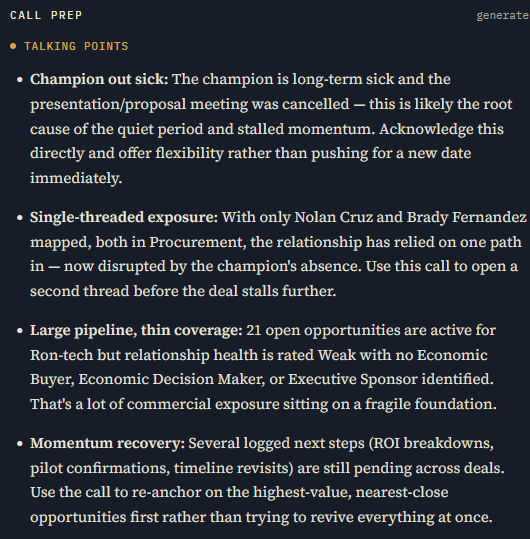
Talking points grounded in this account's real situation — the real reason it's gone quiet, the real risk in relying on one contact, and where to focus first.
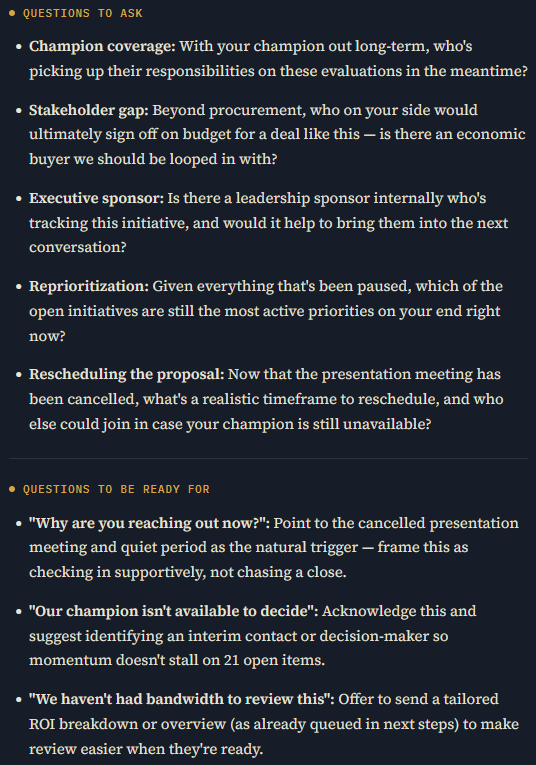
Specific questions to ask the customer, and the objections you should expect back — each grounded in this account's actual gaps, not a generic script. Worked out before you're in the room, not during it.
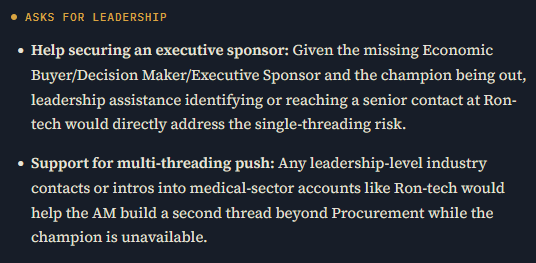
A clear account summary, the real risks and escalations, and specific asks for leadership — so getting help internally is as easy as getting ready for the customer call.
Dashboards don't retain revenue. People do. The tool doesn't do the job for you — it's the combination of your judgment and the real intelligence behind it that gives every account its purpose and direction.
This isn't about ticking boxes or logging more activity. It's about actually knowing the account well enough that the customer feels it — the history you remember, the stakes you understand, the follow-through that proves the relationship matters to you as much as it does to them.
If genuine, lasting client relationships matter to your business as much as the revenue they represent, leave your email and we'll reach out when there's something worth showing.
Thanks — we'll be in touch.
No spam. One email, if and when early access opens.